

LS Tractor Loader Lift Capacity: What the Numbers Mean
Loader lift capacity is one of the first numbers buyers ask about. Here is how to read the spec honestly, and why rear ballast is not optional.
Most people shopping for a compact tractor spend a lot of time on horsepower. Horsepower matters, but the number that tells you whether a tractor can actually do loader work is the lift capacity. It is worth slowing down and reading it correctly.
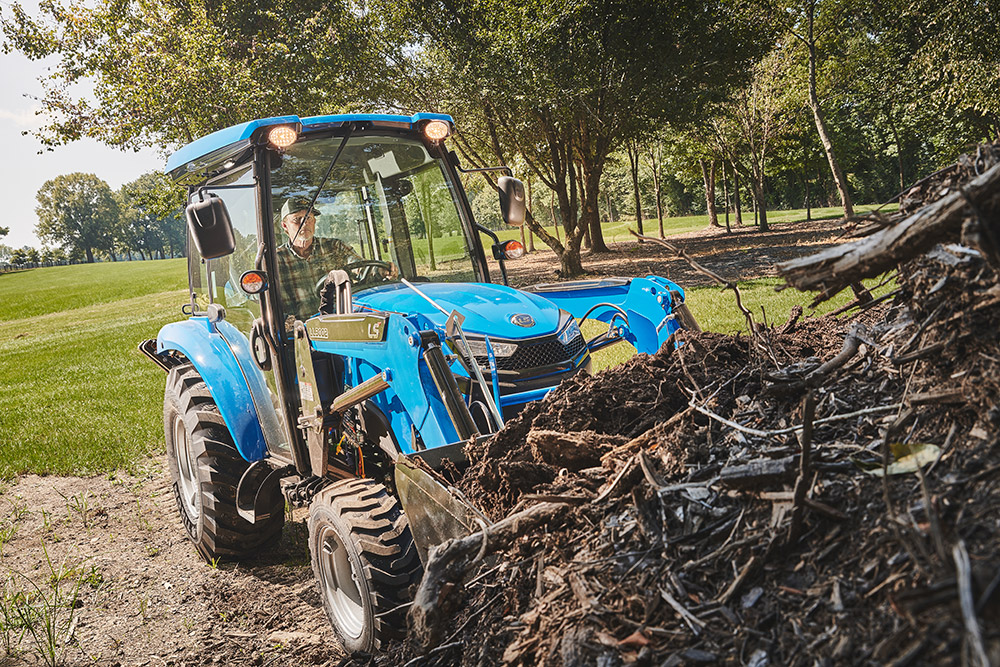
What the rated lift number actually means
The published lift figure, say 1,965 pounds for the LL3002 loader that pairs with the MT226E, is the amount of weight the loader can raise to full height with the bucket level. It is measured at the pivot pins. That is not the same as what sits usably in the bucket. A full bucket of wet dirt can press right against that limit, which is why you learn the real-world ceiling by running the machine, not just reading a spec sheet.
The LS loaders we carry are factory-matched to each tractor frame. The LL3002 on the MT226E compact lifts 1,965 pounds on a 66-inch bucket. Step up to the MT232HE or MT242HE and you get the LL3003, which lifts 2,506 pounds on the same 66-inch bucket. Move into utility territory and the LL5001 on the MT463 brings 3,487 pounds on a 78-inch bucket. The loader is sized for the frame. You cannot spec a bigger loader and skip upgrading the tractor.
Here is a quick look across the lineup we stock:
| Tractor | Loader | Lift Capacity | Bucket Width |
|---|---|---|---|
| MT226E | LL3002 | 1,965 lb | 66 in |
| MT232HE | LL3003 | 2,506 lb | 66 in |
| MT242HE | LL3003 | 2,506 lb | 66 in |
| MT347HC | LL3003 | 2,506 lb | 66 in |
| MT463 | LL5001 | 3,487 lb | 78 in |
| MT473CPS | LL4001 | 2,998 lb | 72 in |
Each row restates specs from the factory match. No configuration lets you swap a heavier loader onto a lighter frame.
What you can actually lift day to day
A round bale of hay in South Mississippi typically weighs 800 to 1,200 pounds dry, and heavier when it has been sitting in rain. A full yard of compacted gravel runs around 2,800 pounds. Brush piles are unpredictable. Wet clay is heavy. Mulch bags are light until there are 20 of them.
A 1,965-pound loader handles most work on a 5 to 15 acre place: gravel, feed sacks, small brush piles, and moving lighter round bales. A 2,506-pound loader covers the same jobs with real margin, and handles a standard dry bale confidently. Once you get into regular hay handling, consistent bale moving, or large dirt jobs, the LL5001's 3,487 pounds changes what a day in the field looks like.
Ballast is not optional
Here is the part that catches first-time owners off guard. When you pick up a heavy load at the front, the rear tires lighten. On a 3,200-pound compact with a loader, picking up 800 pounds at the front can shift enough weight forward to reduce rear traction and steering control, especially going uphill with a full bucket.
The fix is rear ballast: suitcase weights mounted on the rear hitch frame, cast wheel weights, or calcium chloride in the rear tires. A rough guide that holds up in practice is to add about 30 to 35 percent of the loader's rated lift as rear ballast. On the LL3002's 1,965-pound rating, that works out to roughly 600 to 700 pounds behind the rear axle.
We can talk through the right ballast setup for your specific jobs. Come by the lot, tell us what you are moving and how your land lays, and we will size it out.
Who should think twice about a loader
If your main work is mowing, tilling, and running a rotary cutter, a loader adds cost and front-end weight without much benefit. Some buyers are better served by a lighter tractor with a rear-mounted attachment than a heavier machine with a loader they will rarely use.
That said, most folks who buy without a loader end up wishing they had one within the first season. The jobs you did not plan for show up every time.
One more thing: loader versus hitch lift
The loader lift number and the three-point hitch lift number are not the same thing. On the MT226E, the loader lifts 1,965 pounds at the front. The Cat I hitch at the rear lifts 1,808 pounds. Both figures matter, and both come out of our compact and utility lineup. A post on three-point hitch and PTO basics is already on the LS blog if you want to dig into the rear end specs.
Come run one on the lot at 3069 Hwy 49 in Collins, or call us at (601) 516-7255. The LS attachment page has loader specs for every series we carry if you want to compare before you make the drive.