

Rotary Cutter vs Box Blade vs Land Grader for Your Tractor
A plain-English guide to choosing between a rotary cutter, box blade, and land grader for South Mississippi property owners.
Three implements come up in nearly every tractor conversation we have at Dykes Motors: the rotary cutter, the box blade, and the land grader. All three hook to the three-point hitch. All three handle property work. But they do very different things, and picking the wrong one costs you a season of frustration.
Here is a straight look at each one, what it is good for, and how to match it to your land and your tractor.
What Each One Does
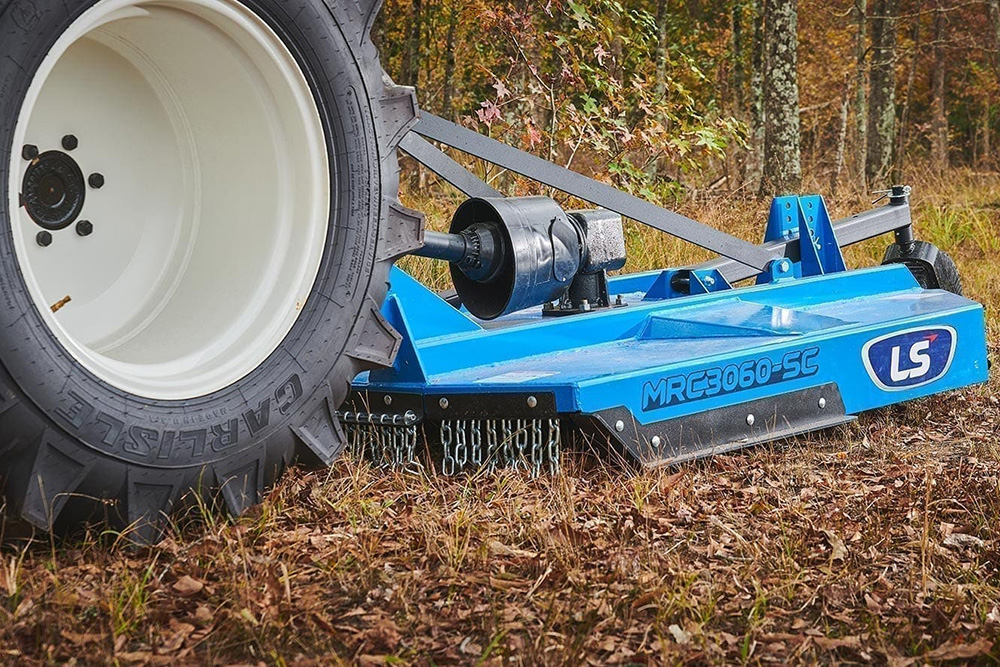
Rotary cutter. A rotary cutter, which most people around here call a bush hog, is a PTO-driven mower. It spins a heavy steel blade on a gearbox and cuts tall grass, brush, weeds, and light saplings. This is the workhorse for keeping pastures knocked down, managing fence rows, and clearing food plots after a growing season. It does not grade or move dirt. In our LS attachments lineup, we carry two sizes: the MRC3060SC, a 60-inch regular-duty unit with a slip clutch, and the MRC5072SC, a 72-inch heavy-duty version also with slip clutch protection.
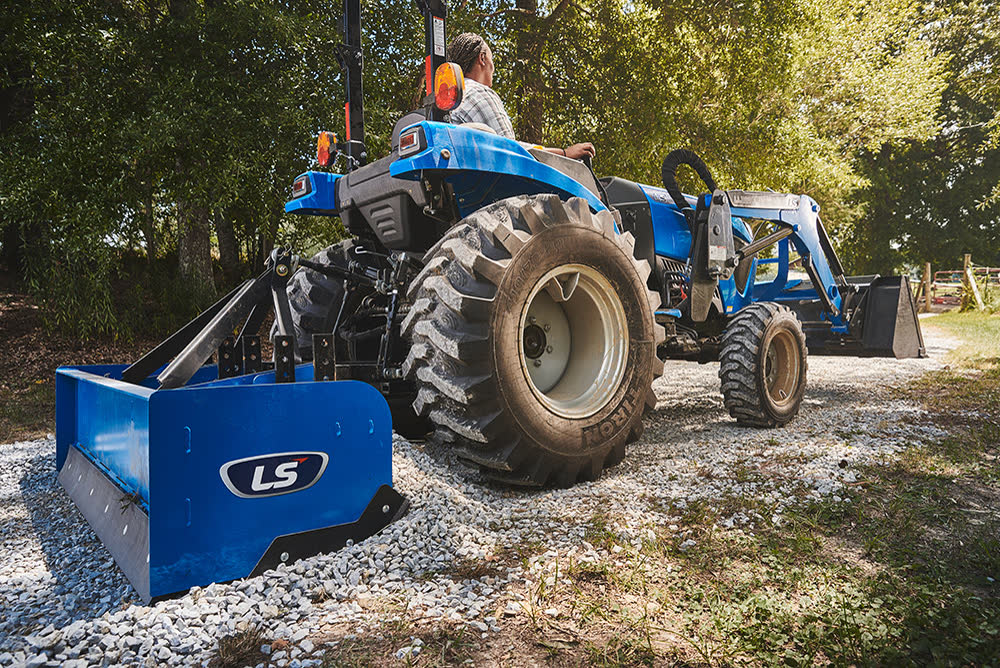
Box blade. A box blade has a fixed cutting edge across the bottom, a rear moldboard, and two rigid side plates that form the box shape. On the forward pass it scrapes and cuts soil. On the reverse pass it traps material inside the box and deposits it where you need it. This is the right tool for shaping driveways, filling in ruts, spot-leveling pads, and cleaning up after a rain event opens up your road. It does not cut vegetation and it moves material more slowly than a grader on long runs.
Land grader. A land grader angles an offset blade across the tractor centerline. The blade skims and windrows material to one side, moving a lot of dirt quickly on long passes. A land grader shapes a long gravel road or levels a large open area faster than a box blade. The tradeoff is precision: the grader covers ground fast but gives you less control on small, detailed leveling jobs. The MLG3060 in our lineup runs a 60-inch blade and mounts on any tractor with enough rear hitch lift to carry it.
Quick Comparison
| Rotary Cutter | Box Blade | Land Grader | |
|---|---|---|---|
| Primary job | Cut grass and brush | Level, fill, and shape | Grade and move material fast |
| PTO required | Yes, 540 RPM | No | No |
| Best fit | Pasture, food plots, fence rows | Driveways, pads, small ruts | Long gravel roads, large flat areas |
| Works in vegetation | Yes | No | Minimal |
| Precision on detail work | Low (area mowing) | High | Medium |
| Our models | MRC3060SC (60"), MRC5072SC (72") | Available, call for stock | MLG3060 (60") |
Matching to Your Tractor
The rotary cutter is the one implement where your PTO horsepower number actually matters at purchase time.
The MRC3060SC is sized for tractors in the 20 to 35 PTO HP range. The MT232HE puts out 26.2 PTO HP and runs the 60-inch cutter cleanly through August pasture grass in Covington County. If you push it into thick timber brush you will slow the engine, so set your expectations accordingly. The MRC5072SC, the 72-inch heavy-duty unit, wants at least 30 PTO horsepower and works better with 35 or more. The MT242HE at 34.8 PTO HP is a solid match for the larger cutter, and the MT3 series with 36 to 48 PTO HP handles anything the 72-inch deck can face. You can see the full compact tractor lineup and utility tractor lineup to compare PTO HP across models.
The box blade and land grader are 3-point hitch tools with no PTO involvement, so the relevant number is rear hitch lift capacity. The MT2E series hitch lifts 1,808 pounds at the hitch end, which handles a standard 60-inch box blade or the MLG3060 land grader without issue. The MT3 series steps up to 2,755 to 2,910 pounds at the hitch end, which opens the door to heavier blades and graders on harder ground. A sub-compact in the MT1 class at 992 pounds of lift will not carry a full-size box blade safely, so size matters.
Who Ends Up With More Than One
Most places on 5 to 20 acres need a cutter first. It gives the most visible result the most often. Pasture management, food plots, and fence row cleanup are recurring jobs.
Add a box blade when the driveway needs serious reshaping or you are grading a pad for a building. Add a land grader if you are maintaining a long gravel road where speed of coverage matters more than fine detail. These are tools for different jobs. Trying to use a cutter on a gravel driveway or a box blade to manage an overgrown field just grinds equipment and produces poor results.
If you are not sure which combination fits your property and your tractor, come out to 3069 Hwy 49 in Collins. We can walk through the attachment options, check what pairs correctly with what you are driving, and answer it in one conversation. You can also call us at (601) 516-7255 or browse the full LS attachments page before you come in.