

3-Point Hitch and PTO Basics for First-Time Tractor Owners
If you're new to tractors, the 3-point hitch and PTO can feel unfamiliar fast. Here's what they are and what to know before you hook up an implement.
Most new tractor owners figure out the loader pretty quickly. Push a lever, lift the bucket, go. The rear of the tractor is where the questions start piling up, and they almost always center on two things: the 3-point hitch and the power take-off.
Neither one is complicated once you have seen it work. Here is a plain-English breakdown of both.
The 3-Point Hitch
The 3-point hitch is a three-arm mounting system on the back of the tractor that lets you attach, carry, and control rear implements. Two lower arms and one upper link form a triangle. Virtually every tractor built after the mid-1950s uses some version of it, so the implements you buy today will fit a tractor you replace it with years from now.
Here is how it works in practice. You lower the arms to the ground, back the tractor up to the implement, slide the implement's hitch pins into the arm ends, and lock them in. The tractor's hydraulics raise the arms, lifting the implement off the ground. Lower them again and it drops down for work.
On the LS compacts we carry, the 3-point is controlled from the seat. Open-station machines like the MT226E and MT232HE use a hand lever on the right fender. The MT347HC cab model has a dedicated rear control lever inside the cab.
Hitch categories. The arms and hitch pins come in standardized sizes called categories. Category I covers most compact tractors and fits the widest range of implements sold for that class. Category II is what you find on the larger MT3 and MT4 machines. Before you buy a used implement, match the category. A Cat II implement will not hook to a Cat I tractor without adapters.
Lift capacity. Every tractor has a rated lift at the hitch ends, measured in pounds. On the LS lineup, that figure ranges from about 992 pounds on the MT1 sub-compacts up to 2,755 pounds on the MT347HC. A standard 60-inch rotary cutter weighs around 700 to 900 pounds loaded. A heavy box blade or grader can push past 1,000 pounds. Your tractor's rated lift needs to cover the implement weight with some margin.
The Power Take-Off
The PTO is a splined shaft that sticks out the back of the tractor. It transfers engine power to implements that need to spin, not just be carried. Rotary cutters, tillers, finish mowers, spreaders, and augers all run off the PTO.
There are two common speeds: 540 RPM and 1,000 RPM. Most compact tractor implements are rated for 540 RPM. Larger utility tractors and heavier commercial equipment often use 1,000 RPM. The implement's manual will tell you which it needs. Always confirm speeds before you buy.
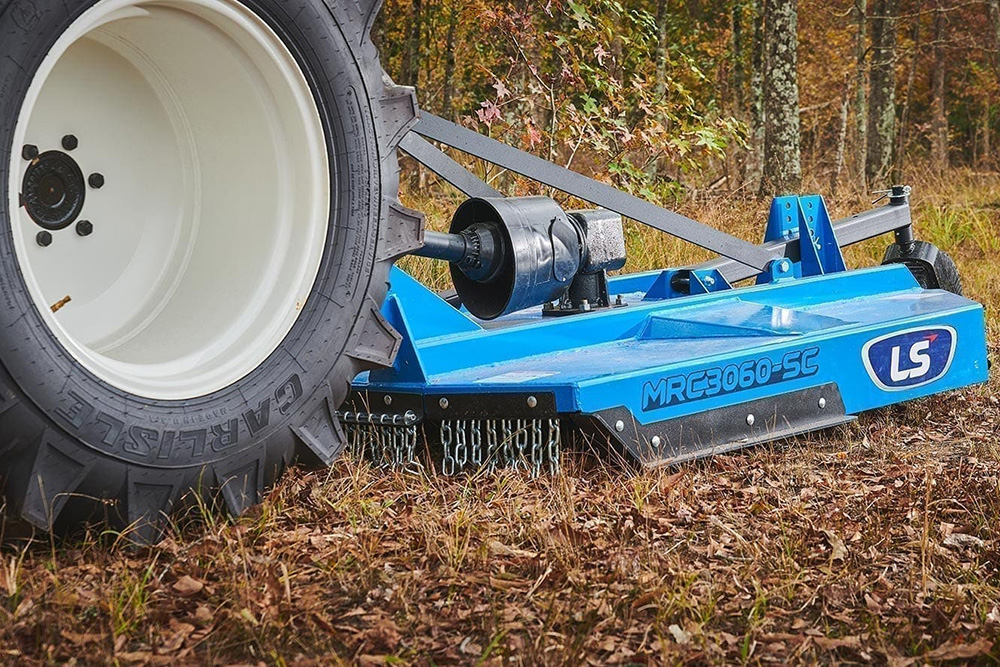
You connect the implement to the PTO stub shaft using a driveline, which is a two-piece telescoping shaft with universal joints at each end. There is typically a slip clutch built into that driveline. If the implement hits a buried rock or root, the clutch slips instead of snapping the shaft or damaging the tractor's gearbox. On the MRC3060SC rotary cutter we carry, the slip clutch is built into the driveline for exactly that reason.
PTO horsepower vs engine horsepower. Every LS tractor has two horsepower numbers. Engine HP is the gross output at the crankshaft. PTO HP is what actually reaches the rear shaft after the drivetrain takes its cut. When you are matching a tractor to an implement, PTO HP is the number that matters.
The MRC3060SC cutter calls for 24 to 50 PTO HP. That puts the MT232HE at 26.2 PTO HP squarely in range, as is the MT242HE at 34.8 PTO HP. The smaller MT226E at 19.2 PTO HP falls below the cutter's minimum, so you would pair it with a lighter implement. Knowing the PTO HP requirement upfront saves a frustrating trip back to the dealer.
Engage and disengage carefully. Always engage the PTO at low engine RPM and bring the throttle up slowly. Never stand near a turning PTO shaft. The universal joints on the driveline create a rotation hazard that is easy to underestimate. Most PTO-related injuries happen because someone walked too close while the shaft was spinning. Keep the shaft guard in place at all times.
A Good Starting Point
If you are new to operating a tractor, ask someone to walk you through a couple of implement hookups before you do it alone. It takes about ten minutes the first time, and most of it becomes second nature quickly. The LS tractors we carry include a 6-year powertrain warranty with no deductible, which covers the hydraulics and PTO system if something does go wrong.
If you have questions about which implements pair with a specific tractor, or you want to see a hookup in person, come out to 3069 Hwy 49 in Collins or call (601) 641-5475. We are happy to walk through it on the lot.